
Most designers will ask for a brief. Most clients hand over a paragraph. Then the project takes twice as long as it should because the first direction was built on assumptions both sides filled in differently.
A brief does not have to be long. It has to answer the right questions.
What the brief needs to cover
Start with the problem, not the output. "We need a new website" is a starting point. "Our current site makes it hard for enterprise buyers to understand our product tier, and we lose deals because of it" is a brief. The second version tells the designer which problems to solve.
Be specific about who it is for. Not "everyone" and not "professionals aged 25 to 45." A specific description of the person who should be most affected by this work. What do they already know? What do they need to feel? What should they do after engaging with this?
Define success as an outcome, not a deliverable. "A website that looks modern" is a deliverable. "We need to reduce the sales cycle by giving prospects the information they need earlier" is an outcome. The designer needs to know what they are optimizing for.
List the real constraints. Budget, timeline, technical requirements, brand guidelines to stay within, assets that must be included. These are not negatives — they are context. Designers work better with real constraints than with infinite freedom.
Show references instead of describing with adjectives. "Premium but approachable" means different things to different people. Three reference images of things in the right direction, and three of things explicitly in the wrong direction, are worth more than a paragraph of description.
What to leave out
Your solution. If you already know exactly what you want designed, you need a production team, not a designer. Briefs that include the designed solution leave the designer no room to improve it.
Unresolved strategic uncertainty. "We are not sure what direction to take the brand" is a strategy problem. Resolve the strategic questions first, then brief the designer.
A format that works
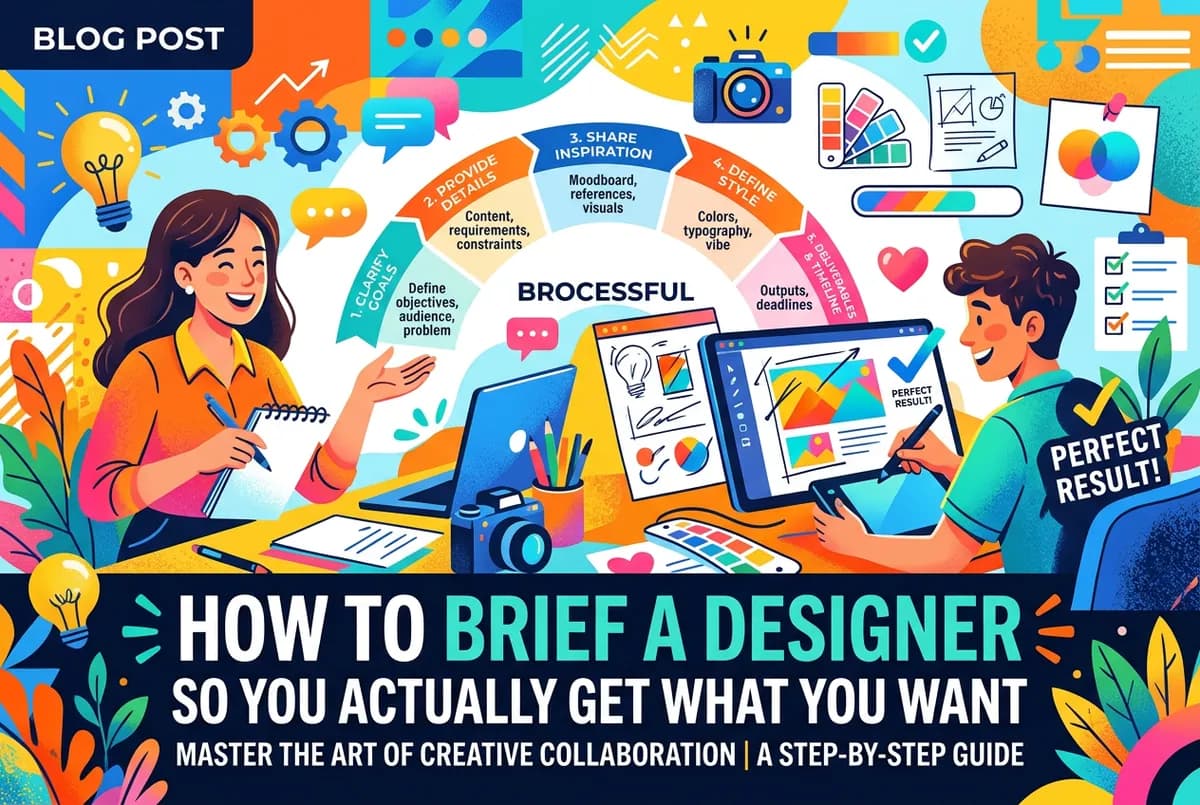
One page, structured: project name and context in two to three sentences, the specific problem being solved, who it is for, what success looks like, hard constraints, three references in the right direction and three in the wrong direction, deliverables expected, and timeline with named decision-makers.
That is enough. More than two pages usually means more questions that need answering before design starts — which is exactly the conversation you should have before the work begins, not during it.