




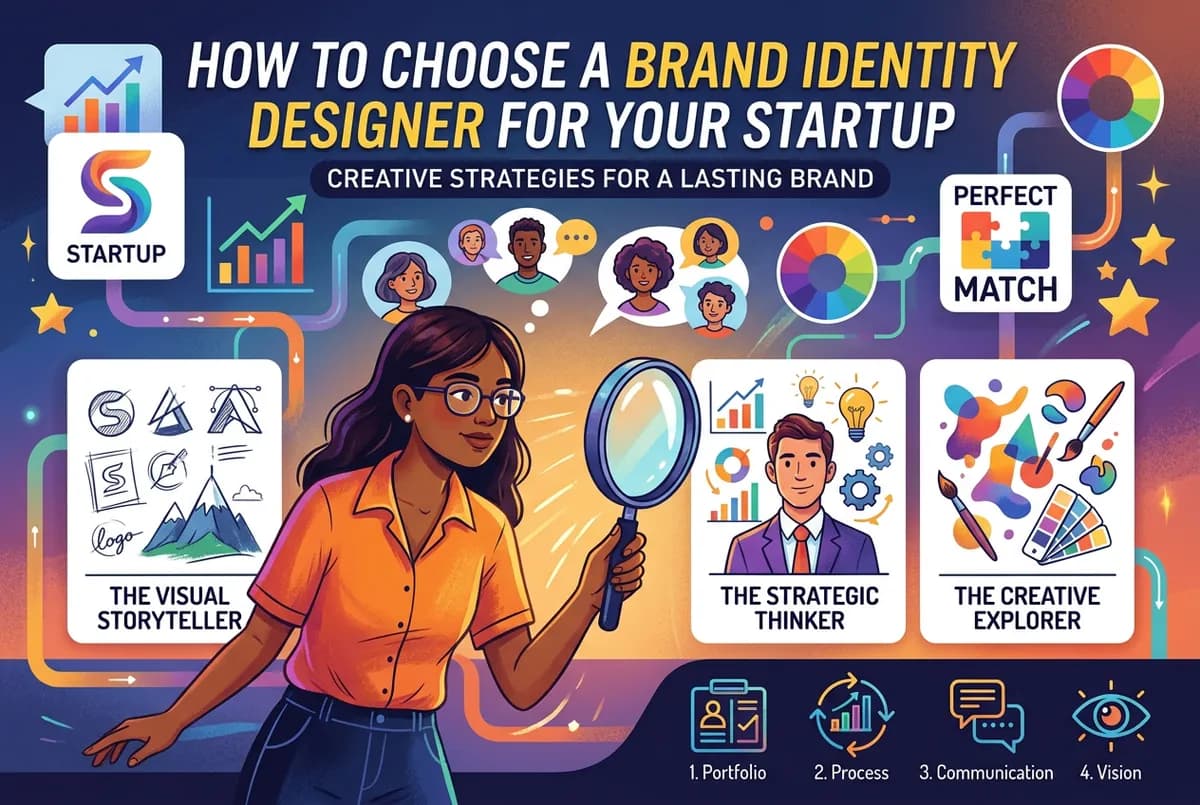
Most founders look at a portfolio and pick whoever made the thing that looks closest to what they want. That is not the worst approach, but it is not the best one either.
Brand identity work is different from most design work because the output is not really a design — it is a system. The logo is probably the simplest part. What matters is whether the designer can make decisions that hold together across contexts you have not thought of yet.
Look at what they designed for, not just what it looks like
A portfolio tells you what the designer has made. It does not tell you whether it worked. The more useful question: what problem was each piece of work trying to solve?
Good designers can answer this without a lot of prompting. They will tell you the client was repositioning from B2C to B2B, or the brand needed to compete on shelf against established players, or the previous identity was alienating younger buyers. The visual choices follow from those constraints.
If the portfolio looks beautiful but the designer cannot explain the reasoning, that is a sign.
Ask how they handle feedback they disagree with
This separates experienced designers from good ones. At some point, a client will push back on something the designer thinks is right. How they handle that moment determines how the project ends.
Ask directly: tell me about a time a client wanted something you did not think was the right call. What did you do? The answer you want is not "I always defer to the client" (a doormat) or "I pushed back until they understood" (a difficult collaborator). It is something like: I presented both options with the reasoning, flagged my concerns clearly, and let them decide.
Check the handoff, not just the deliverables list
Most identity packages include a logo, a color palette, typography, and usage guidelines. The question is whether those guidelines are actually usable by someone who is not the designer.
Ask to see a sample brand guidelines document from a previous project. If it is 80 pages of beautifully formatted restrictions that require a designer to interpret, that is a trophy, not a tool. What you need is something your developer, your social media person, and your print vendor can follow without a meeting.
Ask about file ownership upfront
Standard practice: full ownership transfers to you on final payment. That means source files, not just exported assets. Specifically: vector source files (AI or SVG), font licenses, and any custom assets created for the project.
Some designers retain ownership and license the work to you, which limits what you can do with it later. Some charge separately for source files. Find out before you start, not after.
Look at whether their projects look like each other
A strong identity designer has a defined aesthetic. That is good — it means they have a point of view. But every project they do should still look like it belongs to the client's world, not the designer's portfolio.
If you look at ten projects and they all feel like variations on the same idea, your brand will probably look like project eleven in a series that started before you arrived.
The right designer is not the one whose portfolio you liked most. It is the one who asks better questions than you expected, can explain every choice, and knows what files to hand over when the work is done.